

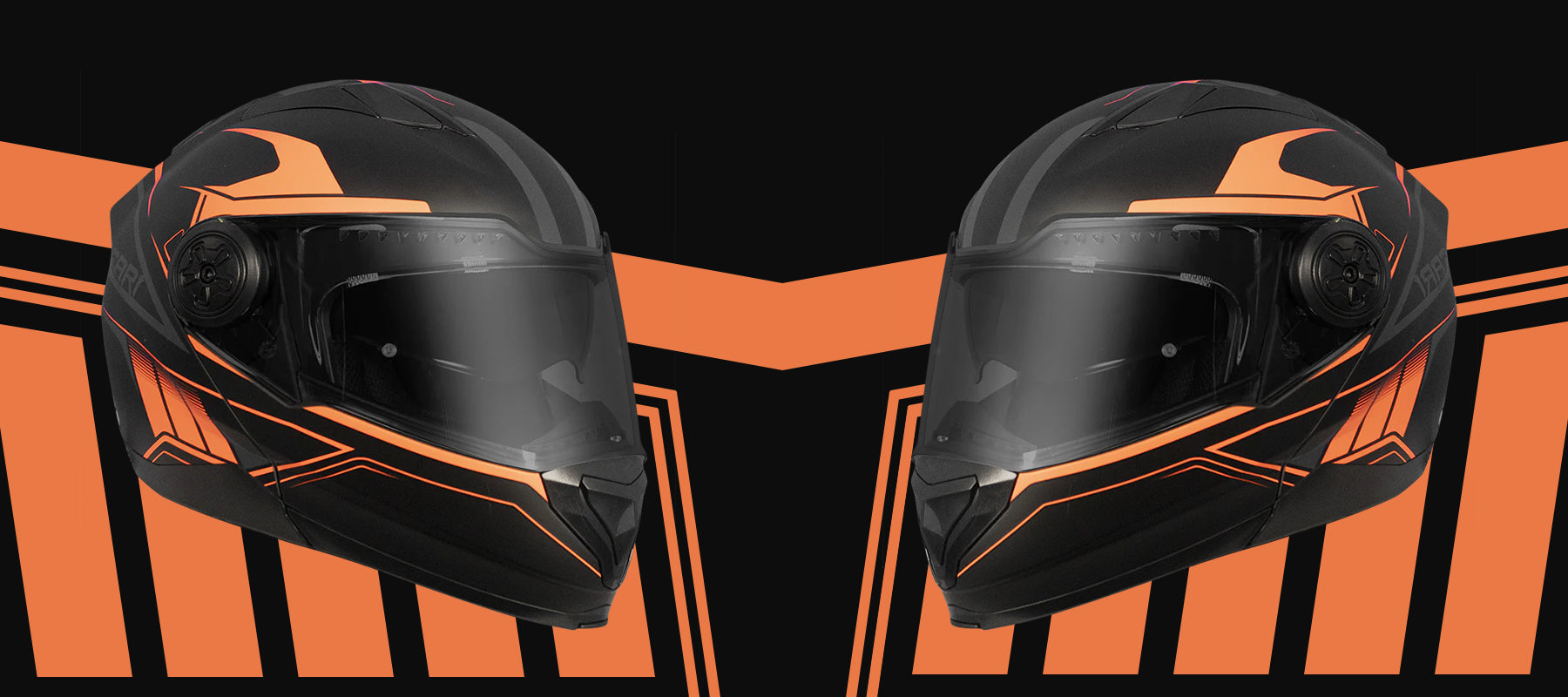
The lights turn red. You want to breathe. You want a sip of water and a word with the mate next to you, and you do not want to pull the whole lid off your head to do it. That is the moment a modular helmet earns its keep. Flip the chin bar up, done.
It is also the moment that explains why modulars exist, why they weigh more than a full face, and why the hinge you just used is the single most-argued-about piece of kit in motorcycle helmets. This is the honest version, tested across modulars we have sold in 2025 and 2026: LS2 FF901 Advant X, AGV Sportmodular, Airoh Rev '19, Airoh Mathisse and Airoh Specktre.
If you commute in traffic, stop often at petrol stations, wear glasses, or run an intercom, a modular is often the right shape of helmet for the job. If you track-day, ride 300km-plus days at highway speed, or you want the lowest possible weight on your neck, a modular is the wrong tool. Here is why.
What a modular helmet actually is
A modular is a full face lid with a hinge across the chin bar. Three physical states:
- Chin bar down, visor down. Full face mode. Aerodynamic, sealed, highway-ready.
- Chin bar down, visor up. Normal around-town setup.
- Chin bar up (flipped). Open face mode. Cool, easy to talk, easy to drink water, legal at low speed in most jurisdictions.
The hinge is the thing you are paying for. It is also the thing you want to test before you buy. Budget modular hinges are rated to thousands of duty cycles. Premium modular hinges are rated to meaningfully more. Commuters who flip at every light find that out fast.
A modular is NOT an open face with a hinge. The shell runs longer in the chin area because the hinge mechanism sits behind a sealed chin bar. That adds 150 to 250g over an equivalent full face at the same price. That extra weight is trade-off number one, and it is honest to name it.
Certification matters twice: once for the chin-closed test (ECE 22.06, mandatory), and once for the chin-open test (P/J rating, optional). Most modulars only carry the first. We will get to why that is the single most important thing on the spec sheet.
The pros, with numbers
Flexibility at low speed. In city traffic or at servo stops, flipping the chin bar gives you 85% field-of-view of an open face without swapping helmets. Over a 50km commute with six stops, that saves you 12 full helmet-offs a week.
Better for glasses wearers. Chin bar up, you put glasses on without dragging the frames across your face or fighting them past the cheek pads. Straight-temple riding glasses still need to be compatible with the closed lid, but the on and off is easy.
Clearer intercom audio at the lights. Intercoms pick up wind noise when a visor vent cracks. Chin up at 0 to 20km/h means the mic is in clean air. Cardo Packtalk and SCS S13 users hear the difference immediately.
Heat management in an Australian summer. A flipped chin bar runs cooler at stops than a sealed full face baking in Queensland sun. A full face stays hot for minutes after you stop moving. The modular vents to ambient the instant the chin is up.
Drop-down internal sun visor. 90% of modulars in our range ship with one. Under $500, modulars are the format most likely to include it. A dedicated full face at the same price is 50/50.
Our family has been selling lids out of Helensvale since 2007. We have watched modulars go from heavy, noisy compromises to properly engineered touring helmets. The best ones now carry the same ECE 22.06 certification as a flagship full face, plus a second certification most buyers do not know exists.
The cons, named honestly
Weight. A modular ships 150 to 250g heavier than a comparable full face. The LS2 FF901 Advant X is 1,650g. The same-tier LS2 FF800 Storm II full face is 1,580g. Across a 500km day, the neck feels it by the last hour.
Noise. The hinge seal is not as tight as a one-piece shell. Expect 1 to 3dB more road noise at 100km/h and above. Earplugs are not optional on a modular at highway speed. If low decibel rating is your priority, a full face wins every time.
Chin bar certification trade-off. Most modulars are certified chin-closed only. ECE 22.06 tests the helmet with the chin bar locked down. Flip it up at 100km/h and you are outside the certified configuration. You have jet-lid protection: crown, sides and back covered, chin and lower face not. Only a P/J-rated modular is impact-tested in both positions. In our current range, the LS2 FF901 Advant X, Airoh Mathisse and Airoh Specktre carry P/J. The budget tier (RXT, Nitro) does not.
Hinge failure over time. Budget modular hinges loosen with enough duty cycles. Commuters who flip 12 to 15 times a day on a 40km commute can eat through a low-rated hinge inside 18 months. A loose hinge at 110km/h means a chin bar that wants to ride up on you. That is worse than no modular at all. Push-test the closed chin bar with a thumb at every service.
Not a race lid. No modular carries Snell M2020. Track day organisers in Australia often refuse modulars regardless of ECE rating. If any part of your riding is track, buy a dedicated full face.
Who a modular is for (and who it is not)
A modular suits you if:
- You commute 10km to 40km each way and stop often.
- You tour and stop often for photos, fuel, food, or conversations.
- You wear glasses.
- You run an intercom on more than half of your rides.
- You carry a pillion and want to talk at stops.
Skip the modular if:
- You do track days.
- You ride weekend canyon runs and want the lowest possible helmet weight.
- You value minimum decibel rating above all else.
- You are an ADV rider who needs a proper fixed peak (look at dedicated adventure lids).
ECE 22.06, P/J rating and what the sticker actually means
Two certifications, one helmet. Understand both and the whole debate gets clearer.
ECE 22.06 is the European standard that replaced 22.05 in January 2024. Every modular we stock in 2026 is 22.06 certified. The 22.06 test adds rotational impact testing at multiple angles, multi-point impact on the same shell, and a tougher anti-abrasion visor test. It is notably tougher to certify than the 22.05 it replaced, per UNECE. ECE 22.06 is also legal on-road in every Australian state and territory, same as AS/NZS 1698.
P/J rating is the separate approval that some modulars carry. P stands for Protective: the helmet passes the ECE 22.06 chin impact test with the chin bar closed. J stands for Jet: the helmet also passes an open-face chin-area test with the chin bar up. A P/J rated modular is certified in both configurations. Ride it chin-open at highway speed and you still have certified impact protection.
A non-P/J modular is protective chin-down only. Chin up is jet-style comfort, not certified chin impact. Know which one you have. At Shark, we judge every modular we stock the same way we have judged helmets since 2007, against a family standard that started after Matthew crashed. It is why we list the P/J mark on every modular product page, and why we push buyers toward the rated options when the budget allows. The long version lives on our about page.
What we stock in 2026
Five modular models we would ride ourselves, across three price tiers. Full range is on the modular helmets collection.
LS2 FF901 Advant X Solid, $739.99 RRP. The value answer. Polycarbonate and fibreglass blend shell, 1,650g, ECE 22.06 with P/J rating: one of the few under-$1,000 modulars impact tested in both chin-closed and chin-open positions. Drop-down internal sun visor. Linkin-ready (LS2's bolt-in intercom module, or fit a Cardo or SCS in the same cutouts). Use case: touring rider who flips at every stop and wants that flip certified. Trade-off: 1,650g is heavier than a Storm II full face at the same tier. If you never flip, you do not need the Advant X.
AGV Sportmodular Glossy Carbon, $999 RRP. The premium answer. Full carbon shell, 1,320g (per AGV published spec), ECE 22.06. This is the only full carbon modular we stock. 330g lighter than the LS2 Advant X, which matters on a three-day run down the Great Ocean Road. Use case: sport-tourer, weekend rider who wants to stop for fuel and coffee without pulling the whole lid off. Trade-off: the shell is tuned for sport geometry, so the riding position runs forward. It is not a comfort-first tourer.
Airoh Mathisse, $599.95 RRP. The Italian mid-premium pick. HRT thermoplastic shell, double P/J certified (tested chin-closed AND chin-open), ECE 22.06, thicker cheek pad liner than the budget tier, quieter hinge seal. Use case: touring rider who wants certified chin-open protection under $600 without stepping up to AGV pricing. Trade-off: thermoplastic holds slightly more heat than a carbon shell at long stops in the sun.
Airoh Specktre, $299.95 RRP. The budget-friendly P/J rated modular. Thermoplastic shell, ECE 22.06, double P/J certified, basic liner. Use case: occasional flipper who wants certified chin-open protection without touring-tier spend. The Specktre is the best P/J rated modular under $500 we stock. Trade-off: less liner depth than the Mathisse, no premium features.
Airoh Rev '19, $699.95 RRP. Mid-premium Italian option. Thermoplastic shell, ECE 22.06, quieter hinge seal than the budget tier, thicker crown liner. Use case: touring rider who wants Italian build without the AGV price tag. P/J status: check the product page before purchase.
Every helmet on that list ships free Australia-wide over $200 from our Gold Coast warehouse. If the model you want is not in the list above, the full lineup including RXT and Nitro budget options is on the modular collection page.
Frequently asked questions
Are modular helmets legal to ride with in Australia?
Yes. Every modular helmet in our range carries ECE 22.06 certification, legal on-road in every Australian state and territory. ECE 22.06 and AS/NZS 1698 are both nationally accepted. Riding with the chin bar flipped up at highway speed is not illegal under Australian road rules, but it is not a certified configuration unless the helmet is P/J rated. In our current lineup the LS2 FF901 Advant X, Airoh Mathisse and Airoh Specktre carry confirmed P/J ratings.
Is a modular helmet as safe as a full face?
Chin bar closed, a P/J rated modular passes the same ECE 22.06 chin impact test as a comparable full face. Chin bar up, only P/J rated modulars carry certified chin protection in that position. Non-P/J modulars are chin-closed certified only, and the chin-up configuration is comfort, not crash protection. The hinge also adds a mechanical failure point that a one-piece full face does not have. Budget modular hinges typically show felt play inside three years of daily commuting.
How much heavier is a modular than a full face?
150 to 250g heavier at the same price tier. The LS2 FF901 Advant X modular is 1,650g. The LS2 FF800 Storm II full face is 1,580g: 70g lighter, at $249 versus $739.99. Over a 500km day, the neck and upper back feel the extra weight by the last hour. If you tour 1,000km weeks and rarely stop, a full face deserves a look. If you stop often, the flip function earns its weight penalty.
Can I use an intercom with a modular helmet?
Yes, and the flip function gives clearer mic audio at stops than visor-venting a full face at the lights. This is one of the actual advantages of the modular format. The LS2 FF901 Advant X ships Linkin-ready out of the box. The AGV Sportmodular fits standard 40mm speaker cutouts for Cardo and SCS intercoms. Budget modulars like the RXT and Nitro ranges have basic pocket cutouts that fit most slim speaker sets. Check the product page for "intercom ready" before you buy.
How often should I replace a modular helmet?
Five years from date of manufacture, or seven years from first use, whichever comes first. The DOM sticker sits under the chin strap. For modulars specifically: if the hinge develops play you can feel with a thumb push on the closed chin bar, retire the helmet regardless of age. A loose hinge at highway speed is a known failure mode on older budget modulars. It does not fail gradually. It fails at the moment you least want it to.
Ready to compare the range? Modular motorcycle helmets are on one page with prices, weights and certifications. Prefer a full face? Full face motorcycle helmets live here. For the broader decision, read our 2026 motorcycle helmet guide.

Share:
Is It Safe to Use a Half-Face Helmet?
An Expert Review of the 8 Best Modular Helmets in Australia in 2024