

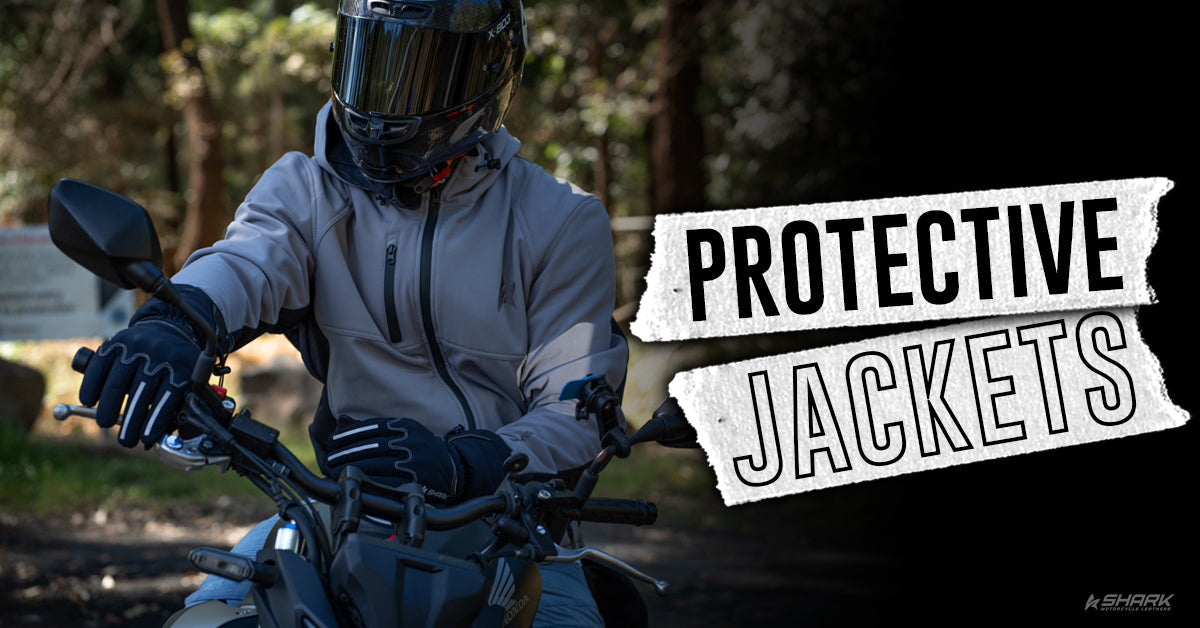
Most riders buy the wrong jacket twice. First time they go cheap and find out a hot Aussie summer kills the membrane in two seasons. Second time they overspend on a track-spec leather they wear three times a year. The trick is buying for the riding you actually do, in the conditions you actually ride in.
This guide covers what each material is built for, what EN 17092 ratings actually mean, how CE armour levels stack up, and which jacket type protects what.
We've been fitting jackets out of Helensvale since 2005. A lot of the calls into the shop start with "my mate said". Most of that tips are wrong by a decade. The standards changed in 2018 and again in 2022. Here's what's current, and what we actually stock.
The four jacket materials (and what each is for)
Leather
What it does well: best abrasion resistance per gram on the market. A 1.2mm to 1.4mm cowhide jacket will slide on hot bitumen for 8 to 12 metres without breaking through. Kangaroo at the same weight does it in 6 to 10. The fibre structure of animal hide doesn't melt, doesn't tear cleanly, and stretches before it fails.
What it does poorly: heat retention. A leather jacket at 32 degrees in Brisbane traffic is brutal. Even perforated leather sits 4 to 6 degrees warmer than mesh textile in stop-go conditions. Cleaning is a chore (saddle soap, conditioner every 6 months). Soaked leather takes 48 hours to dry properly, and forced drying (in a tumbler or near a heater) cracks the grain.
What it costs in our shop: $300 to $1,200 across the leather range.
What we stock:
- Shark Tract Jacket ($300). Our own-brand cafe-racer cut in 1.2mm cowhide. CE armour pockets, AA rated abrasion. Unisex available in black.

- Shark Summer Cruise Jacket ($210). Lightweight perforated leather, urban cruise styling. Built for QLD summer riding.

- Shark Ladies Sherpa Trucker Jacket ($399). Sherpa-lined leather, casual cut, women's-fit.
- Berik Apex ($500). Race-leaning sport leather with CE armour throughout. Black/Hi-Vis option for visibility.
- Berik Monza ($600). Classic Italian race leather, AAA rated abrasion at impact zones.
- Berik Sicily ($900). Premium 1.4mm cowhide, AAA rated, racing-spec cut.
- Berik Mugello ($1,200). Top-tier track-spec leather, full AAA rating, kangaroo at impact zones.
- Berik Imola ($280 entry). Berik's entry leather race jacket. Class AA, CE armour, sport cut.
Best for: cooler riding (sub-25 degrees), highway and twisty work, anyone doing track days, riders who prioritise abrasion protection above all.
Browse leather motorcycle jackets.
Textile (Cordura, ballistic nylon, polyester weaves)
What it does well: handles heat better than leather, dries faster, easier to clean (machine washable on most models), built-in pockets and waterproof membranes are simpler to integrate. A modern Class AA textile jacket will protect comparably to leather at urban speeds (under 70km/h).
What it does poorly: abrasion at sustained high speed. A 600D Cordura jacket will burn through in 4 to 6 metres of slide where leather goes 8 to 12. The trade-off is real but most road crashes don't go 12 metres anyway.
What it costs: $150 to $500 across the textile range.
What we stock:
- Shark Project Tourer Jacket ($699). Our own-brand 3-season touring textile. Waterproof + thermal liners, CE Level 2 shoulder/elbow armour, ventilation panels.

- Shark Ladies Breeze Jacket ($199). Women's-fit summer textile with CE armour.
- Difi Sierra Nevada 3 Aerotex ($430). European touring textile, Gore-Tex grade waterproof, CE Level 2 armour. Multiple colour options.
- Macna Combat Jacket ($350). Tactical-cut textile with CE armour. Heavy weight for cooler months.
- Macna Habitat Jacket ($350). Adventure-touring textile, multi-pocket, integrates with hydration packs.
- Macna Aytee Jacket ($450). Tactical mesh-textile hybrid, summer-leaning with thermal liner.
- Macna Flight Jacket ($150). Lighter textile cut, entry tier.
- Merlin Barton II D3O ($500). UK heritage cafe-racer textile with D3O armour and waxed cotton finish.
- Merlin Badou D3O ($400). Touring textile with D3O armour, integrated rain cover.
Best for: commuters, year-round riders, anyone in QLD/NT who can't tolerate full leather in summer, ADV riders.
Browse textile motorcycle jackets.
Mesh (perforated textile, often Cordura mesh + impact panels)
What it does well: airflow. A mesh jacket with armour at the shoulders and elbows lets 60 to 80 percent of the airflow through compared to a closed textile. The difference at 80km/h on a 35-degree day is the difference between cooked and rideable.
What it does poorly: rain (most aren't waterproof, by design), and abrasion in slow-speed crashes if the mesh tears (the impact panels around shoulders, elbows and spine are full Cordura; the mesh between them is the weak point).
What it costs: $150 to $450.
What we stock:
- Shark Summer Cruise Jacket ($210). Perforated leather counts as a heat-management hybrid. Heaviest airflow option in leather.
- Macna Aytee ($450). Mesh-leaning tactical jacket with CE armour throughout.
- Macna Flight ($150). Lightweight mesh-cordura entry textile.
Best for: Queensland and NT summer riders, urban commuters who can switch jackets seasonally, anyone whose only complaint about their current jacket is the heat.
Aramid fibre (Kevlar) garments
What it does well: aramid fibres (Kevlar is the most famous brand) resist abrasion at roughly 4 to 5 times the rate per gram of standard polyester. The genius of an aramid garment is hiding motorcycle protection inside something that looks like a hoodie, cargo pant or chino. The commute-to-cafe rider who wouldn't wear a jacket can wear an aramid-lined hoodie all day.
What it does poorly: a fully aramid-lined hoodie is typically EN 17092 Class A (urban) rated. Not B (road). Not AA (street/touring). Not AAA (race). For sustained highway riding (above 100km/h), you want a jacket above the hoodie, or an upgrade to a textile AA.
What it costs: $130 to $300 for hoodies. Pants in aramid-lined denim or chino: $130 to $300.
What we stock (hoodies and protective tops):
- Shark Phantom Protective Hoodie ($300). Our own-brand flagship. Full aramid-fibre lining from collar to hem. Armour pockets at the shoulders, elbows and back. Unisex cut.
- Shark Single Layer Protective Hoodie ($329). Entry aramid-lined hoodie. Class A EN 17092.
- Shark Cruiser Protective Flannel ($210). Aramid-lined flannel shirt cut. Looks like everyday wear.
- Shark Repel Winter Hoodie ($275). Thermal-lined aramid hoodie for cooler months.
- Merlin Hamlin II ($280). UK heritage hoodie with Class AA shell construction. Brushed polyester shell, kangaroo pouch, hidden zip pocket.
Best for: daily commuters under 80km/h, riders who hate looking like they ride, anyone going coffee-to-bike-to-work in one outfit.
Browse kevlar gear and protective tops and motorcycle hoodies.
EN 17092: what the rating actually means
EN 17092 is the European garment standard adopted in Australia as the de facto motorcycle garment cert. It runs in four tiers, ranked by abrasion resistance and impact distribution at standardised test speeds.
Class A (Urban)
Tested to protect a rider in a 45km/h impact slide. This is your hoodie tier. Aramid-lined garments and entry mesh jackets sit here. Class A is good enough for a commute that mostly stays under 80km/h and never goes near a highway at full speed.
Class B (Reduced abrasion zones)
Same impact tests as Class A but additional reinforced abrasion zones. Class B is rare on the AU market because most manufacturers either commit to Class A (cheap mesh, hoodies) or step straight up to AA.
Class AA (Street, Touring)
Tested at 70km/h slide. This is your road-jacket tier. Almost all of our textile and leather jackets sit here. A Class AA jacket with CE Level 2 armour is the practical standard for road riding in Australia. A weekend touring rider on a Pacific Highway run doesn't need more.
Class AAA (Race, Pro Road)
Tested at 120km/h slide. Track-spec leather one-piece suits and our top-tier road leathers sit here. AAA-rated kit costs 1.5 to 3 times what the AA equivalent costs because the leather is thicker, the stitching is doubled or tripled at impact zones, and the armour is heavier-duty.
If you're not on a track or doing sustained 130+ touring on rough Australian back roads, you don't need AAA. If you are, nothing else will do.
What AU riders actually buy
Our data: roughly 70 percent of jacket sales sit at Class AA. 20 percent at Class A (hoodies, mesh). 10 percent at AAA (touring leathers and race suits).
The Class AA + CE Level 2 armour combo is the sweet spot. If you're shopping a first jacket, that's the target.
CE armour levels
Separate from the garment rating. Armour is tested against impact force transmission. The number is the force, in kilonewtons, that reaches your body when the armour gets hit with a standardised drop test.
Level 1
Cuts impact to under 18 kN average, with peaks no higher than 24 kN. Most factory armour shipped in a $300 jacket is Level 1. It's not nothing. A bare elbow getting hit at 18 kN versus a knee in your jeans getting hit at zero protection is the difference between a bruise and a fracture.
Level 2
Cuts impact to under 9 kN average, with peaks no higher than 12 kN. Roughly half the force on the same crash. The performance jump from Level 1 to Level 2 is meaningful and you feel it as a difference in the armour weight and density, not just a sticker.
Type A vs Type B
Type A armour covers a larger area. Type B covers a smaller area. For shoulders, elbows, knees and hips you want Type A coverage. Spine armour comes in three sizes (S, M, L). Get the size that runs from the bottom of your neck to your tailbone with the armour in place.
What we recommend
Class AA jacket + CE Level 2 Type A armour at shoulders, elbows AND spine. The spine is the one most jackets ship without (you have to add it, usually $89 to $129 for a Level 2 spine insert). Don't skip it.
Compatible spine inserts we stock:
- Macna R.I.S.C. Armour Chest CE Level 1 ($80). Chest protector that fits most Macna jackets.
- Macna R.I.S.C. Armour Knee/Elbow CE Level 1 ($40 per pair) or Level 2 ($60 per pair).
- Merlin D3O Viper Stealth CE Level 1 Back Protector ($70).
How to choose: by use case
Daily commute, mixed weather, sub-80km/h
A textile Class AA jacket with CE Level 2 armour. Shark Project Tourer Jacket ($699), Macna Combat ($350), or Macna Aytee ($450). Adds a thermal liner for winter, vents open in summer.
Weekend tourer, 100-200km Saturday rides
Same as commute, but step up to a touring-cut textile or a road-spec leather. The cut matters because you'll be in it for 4-6 hours. Difi Sierra Nevada 3 ($430) for textile touring, Shark Tract Jacket ($300) for leather, Merlin Barton II D3O ($500) for a heritage cafe look.
Track day rider
A Class AAA leather one-piece suit. Or a two-piece that zips together at the waist. Berik Sicily ($900) for a race-spec jacket, or step up to the full Berik Mugello ($1,200) for AAA track-spec. We sell these out of the Helensvale shop and ship Australia-wide. Browse race suits for the full 1-piece options.
Adventure-touring rider
A textile ADV jacket with Gore-Tex or equivalent membrane. Macna Habitat ($350) or Macna Combat ($350). CE Level 2 armour at shoulders, elbows AND spine.
Urban-only commuter (under 60km/h, mostly traffic)
A Class A aramid hoodie. Shark Phantom Hoodie ($300), Shark Single Layer Protective Hoodie ($329), Merlin Hamlin II ($280). Lower abrasion rating than AA, but practical for daily wear if you actually ride at urban speed only.
Sizing and fit
A jacket only protects what it covers, and only when the armour stays in position. Fit matters more than brand.
How it should fit
- Shoulders. Armour pockets should sit on the deltoid (the muscle on the outside of your shoulder), not above it on the trapezius or below it on the arm.
- Elbows. Bent at 90 degrees, the armour should sit at the point of the elbow. Most jackets need to be done up across the chest before checking this.
- Chest. Snug enough that the front zip closes without strain, loose enough that you can take a deep breath. Adjustment tabs at the waist and arms let you cinch fit over base layers or open up over a thermal.
- Sleeves. Long enough to cover your wrists when leaned forward on the bike. Standing upright they'll look "too long". This is correct.
- Hem. Should overlap the top of your pants by 5cm minimum when seated on the bike. A short hem rides up at speed and exposes your lower back.
Sizing chart (general guide, brand-specific)
| Chest measurement | Likely size |
|---|---|
| 86-91 cm | XS |
| 92-97 cm | S |
| 98-103 cm | M |
| 104-109 cm | L |
| 110-115 cm | XL |
| 116-121 cm | XXL |
| 122-127 cm | 3XL |
Every brand has its own chart. We cross-reference yours against the specific jacket before we ship it. If you're between sizes, size up to leave room for a thermal liner or base layer.
Care and lifespan
Leather
- Saddle soap clean every 3-4 months.
- Conditioner (mink oil or proprietary leather conditioner) every 6 months.
- Air dry only. Never near a heater. Never in a tumble dryer.
- Storage: on a wide hanger, not a wire one.
- Lifespan: 8-15 years with proper care, depending on use frequency.
Textile
- Machine wash cold, gentle cycle, no fabric softener (kills the DWR membrane).
- Reproof the DWR membrane every 12-18 months (Nikwax or equivalent).
- Hang dry. Tumble dry low if the label allows.
- Lifespan: 4-7 years for daily use, longer for weekend-only.
After a crash
Any jacket that took an impact: send it for inspection or replace it. The armour is one-shot crush absorption. The garment may look fine but the impact panels under the armour can have stress-failed in ways that aren't visible.
AU-specific notes
Heat
Summer in QLD, NT and northern WA regularly hits 38+ degrees with high humidity. A full leather jacket in those conditions is dangerous if you're commuting (heat exhaustion is a real crash risk). Mesh + thermal-liner-out is the practical answer.
Rain
The Pacific Highway run in autumn is brutal for waterproof claims. A jacket sold as "waterproof" should have factory-taped seams, a properly bonded membrane, and a documented Hydrostatic Head rating (10,000mm minimum). Membranes break down with detergent and UV. Reproof annually.
High visibility
NSW, VIC and QLD road safety strategies recommend hi-vis riding kit. We stock hi-vis options across textile and waterproof cuts. The Berik Apex Black/Hi-Vis ($500) is the visibility-focused leather pick.
FAQs
Do I need a waterproof motorcycle jacket in Australia? If you commute, yes. If you only ride fair-weather weekends, probably not. Waterproof textile jackets run hot above 28 degrees, and the membrane adds weight and cost. A non-waterproof textile with a separate rain shell that packs into a tank bag covers most use cases at lower cost.
Leather or textile for a first motorcycle jacket? Textile. More forgiving in heat, cheaper to replace if you drop the bike in a driveway, and a modern Class AA textile with CE Level 2 armour protects almost as well as leather at road speeds. Our Shark Project Tourer Jacket at $699 RRP is the standard first-jacket pick.
What is the difference between CE Level 1 and Level 2 armour? Level 1 cuts the impact force transferred to your body to under 18 kN average. Level 2 cuts it to under 9 kN. Half the force on the same crash. Always upgrade spine armour to Level 2, even if the rest of the jacket ships with Level 1.
Is a Kevlar-lined hoodie as safe as a motorcycle jacket? No. A protective hoodie is typically rated Class A under EN 17092 (urban). A textile jacket is typically rated AA (street/touring). A race suit is AAA. Class A protects in a 45km/h slide. AA in a 70km/h slide. AAA in 120km/h. Buy by the speed you ride.
How should a motorcycle jacket fit? Snug across the chest and shoulders with armour in place, not loose. Loose armour moves in a crash and stops protecting the joint it was meant to cover. Standing upright the sleeves should look slightly too long. Leaned forward on the bike they cover your wrists. That's correct.
What does AAA rated mean for a motorcycle jacket? EN 17092 Class AAA. Tested to protect against abrasion in a standardised 120km/h slide. Track-spec leather. Costs 1.5 to 3 times what an AA-rated equivalent costs. Required for most circuit track days. Not needed for road riding. Our Berik Mugello at $1,200 is the AAA-rated pick.
Can I retrofit Level 2 armour to a Level 1 jacket? Usually yes. Most jackets accept aftermarket armour in the same pocket shape. Check the armour brand's compatibility list. Macna and D3O armour fit most other jackets with standard armour pockets.
The verdict
The first jacket you buy will be wrong. Most riders learn this the hard way. Here's how to skip the rookie spend:
- Match the rating to the speed. Don't buy AAA if you commute. Don't buy a Class A hoodie if you ride the M1. Class AA + Level 2 armour is the right answer for 80 percent of AU riders.
- Upgrade the spine armour day one. Most jackets ship with Level 1 spine, or no spine at all. The spine is non-negotiable. $40-$70 insert.
- Buy for the weather you actually ride in. Mesh in summer, textile-with-membrane in cooler months, leather for weekend twisties. One jacket can't do everything in Australia.
- Fit beats brand. A perfectly-sized $300 Shark Project Tourer protects better than a loose $1,200 import.
Got questions about specific brands or models? Come into the Helensvale shop or hit us up online. We've fitted thousands of riders and we'll point you at the right jacket for what you actually do on the bike.


Share:
Motorcycle Helmet Sizing Australia | Cert Guide | Shark Leathers
Motorcycle Intercom Comparison & Setup Guide | Shark Leathers